A5 Notebooks: Why Are They the Undisputed Champions of Productivity?
Are you struggling to find a notebook size that is perfect for both daily planning and portability? Using the wrong size can hurt your productivity and memory.
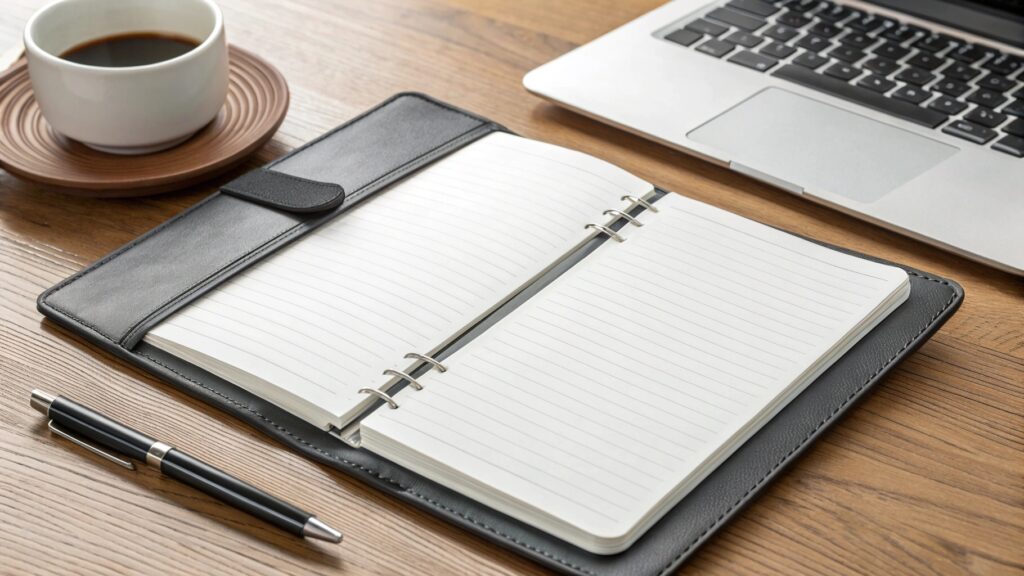
A5 notebooks are the champions of productivity because they offer a psychological balance: they are large enough for structured thinking but compact enough for daily carry. They have become the default format for high-frequency behaviors like habit tracking, journaling, and meeting notes, effectively bridging the gap between temporary digital notes and formal, dedicated archives.
 ![]()
![]()
When I look at the range of products we customize, the popularity of the A5 notebook is not just a trend—it reflects a deeper shift in how people manage attention and productivity in an overloaded digital world. A5 sits precisely between “too temporary” and “too formal.” It creates a balance that helps users commit their ideas to paper. Let’s explore why this specific size has become the most popular choice for journaling and professional use.
What is the Most Popular Journal Size for Daily Writing?
Are you unsure which notebook size is favored by journalers for comfort and commitment? Choosing a size that is too large or too small can discourage daily use.
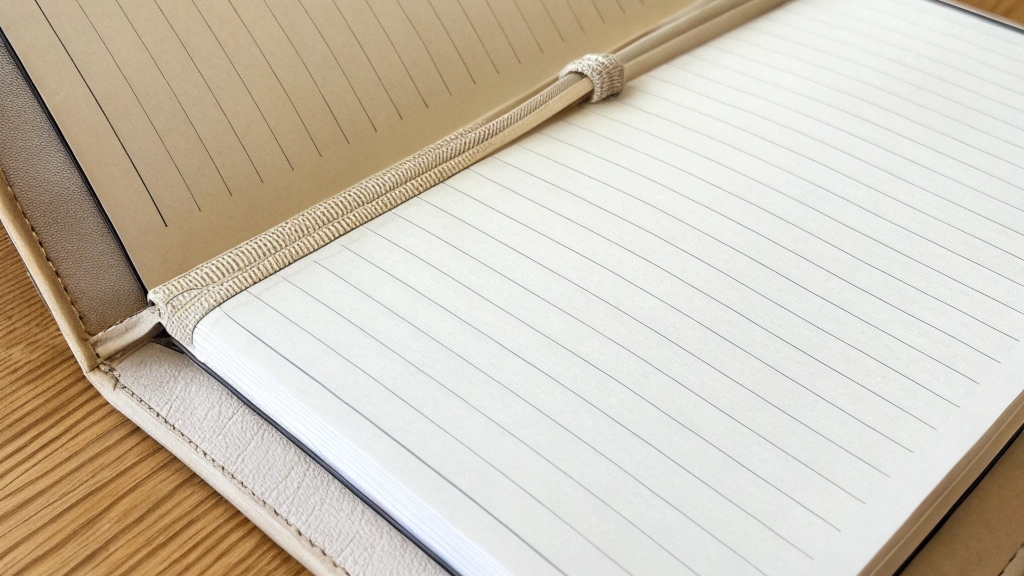
The A5 is the most popular journal size1 for daily writing because its dimensions ($148 \text{ mm} \times 210 \text{ mm}$) offer the ideal compromise between spacious writing surface and portability. It provides enough room to capture thoughts deeply, yet remains light and small enough to be carried everywhere, which encourages the high-frequency use essential for habit tracking.
 ![]()
![]()
The A5 format has quietly become the default choice for personal archiving and journaling, and this is entirely intentional. When I talk about journaling, I focus on the behavioral interface—how the tool encourages the user to write. The A5 size excels here because it feels serious enough to matter, yet small enough to be used daily without pressure. First, consider the commitment level. Unlike a large A4 book that demands dedicated desk space and formal entry, the A5 is non-intimidating. It encourages quick, daily capture. Second, look at portability for habit tracking. Journaling is a high-frequency behavior. The A5 is perfectly sized to fit into most standard bags and backpacks, making it accessible at a café, during a commute, or on a nightstand. This constant presence is critical for forming a daily habit. Third, the paper efficiency is balanced. The size offers enough lines to practice structured thinking and detailed reflection without feeling overwhelming. This efficiency in design means that one well-structured A5 page can often satisfy creative users, professionals, students, and travelers at the same time. This makes the A5 journal a true decision-making tool and a frictionless capture device.
| Notebook Size | Best Use Case | Psychological Barrier |
|---|---|---|
| A4 ($210 \text{ mm} \times 297 \text{ mm}$) | Formal reports, large projects | Feels Too Formal; Limits portability |
| A5 ($148 \text{ mm} \times 210 \text{ mm}$) | Daily journaling, meeting notes, creative planning | Just Right; Encourages high-frequency, continuous use |
| A6 ($105 \text{ mm} \times 148 \text{ mm}$) | Quick lists, contact information | Feels Too Temporary; Restricts detailed thought |
The A5 is successful because it is designed for real-life workflows, not just storage.
Should I Get an A4 or A5 Notebook for Work and Study?
Are you debating between the large writing area of an A4 notebook and the convenience of an A5 for your professional life? Choosing the wrong one reduces efficiency.
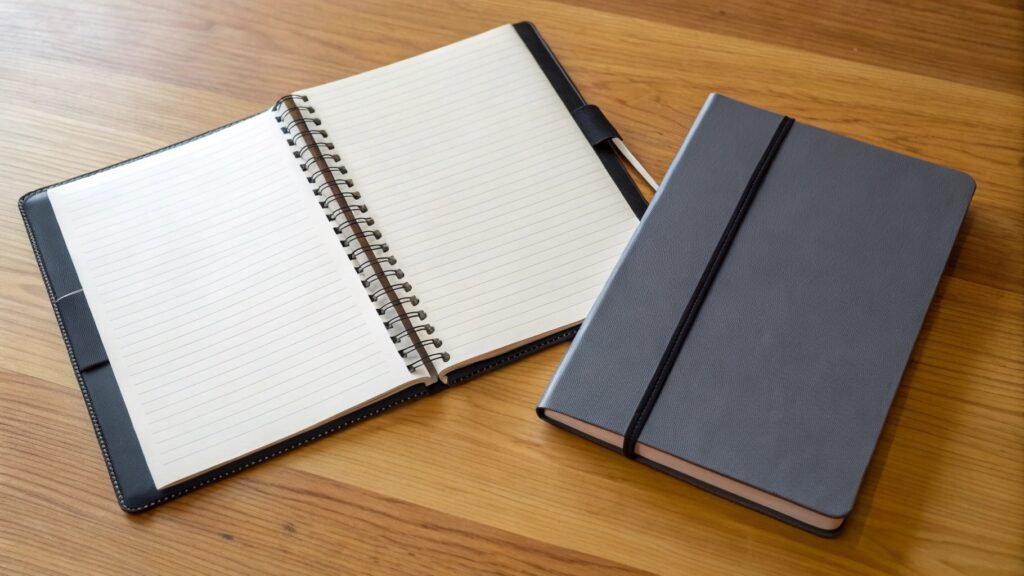
You should generally choose an A5 notebook over an A4 for work and study because the A5’s superior portability and smaller size match the high-mobility and meeting-based demands of modern professional life. The A4 is better reserved for tasks requiring large visual space, like presentations, architectural drafts, or extensive research where maximum viewing area is essential.
 ![]()
![]()
This choice boils down to how you actually use your notebook in your job or study environment. My perspective, honed by watching professional needs evolve, is that A5 is the modern default. First, consider the environment. Most modern work happens in quick meetings, on trains, or in shared spaces. A large A4 notebook2 is cumbersome and takes up too much space on a small table. The A5 is discreet and easy to handle while juggling a laptop and a coffee cup. Second, look at the content capture. A4 is often too large for efficient note-taking; your eyes have to travel too far across the page. A5’s narrower width facilitates quicker, more focused capture of meeting actions and key decisions. Third, remember the archiving process. An A5 notebook is much easier to scan, file, and store digitally without creating excessively large files. The only reasons to choose A4 are for specific tasks—such as technical drawing, coding, or creating mind maps that require massive sprawl. Otherwise, the A5 is the efficient, adaptable format that acts as a long-term personal archive and a reliable capture device, perfectly suited for the dynamic workflow of a marketing manager like Jacky.
| Format Comparison | Primary Advantage | Primary Disadvantage |
|---|---|---|
| A4 Notebook | Maximum writing/drawing space; Good for long documents | Cumbersome to carry; Not ideal for quick, mobile meetings |
| A5 Notebook | Excellent portability; Ideal for focused meeting notes | Limited space for large visual organization or extensive data |
The real competitiveness of a notebook is tied to its functional role in a digital-first world, and A5 wins on function.
What is the Difference Between an A5 Journal and a Pocket Journal?
Are you debating between the committed writing space of an A5 journal and the ultra-portability of a pocket journal (A6)? Confusing their roles leads to unused notebooks.
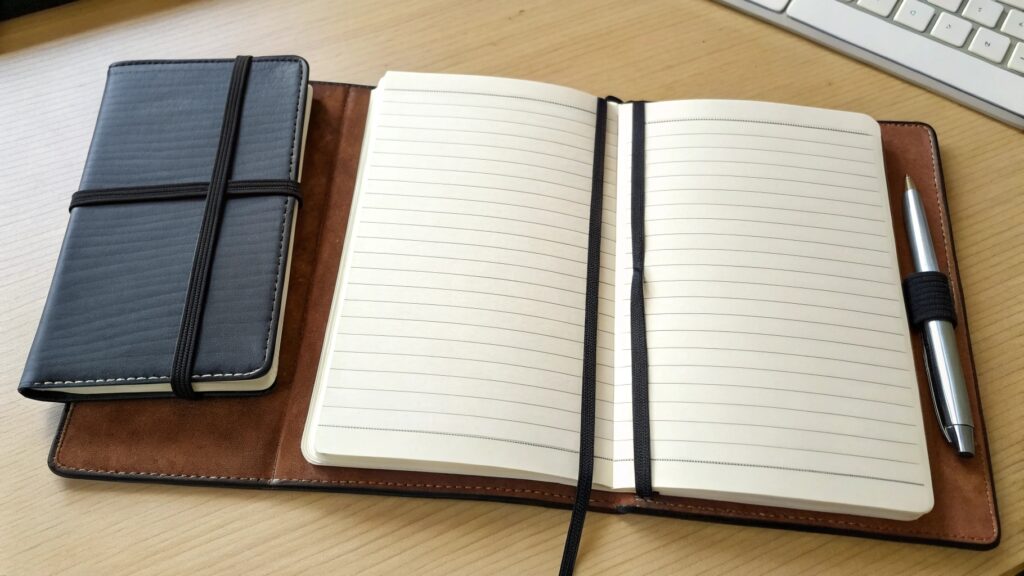
The difference between an A5 journal and a pocket journal (A6) is their intended purpose: the A5 serves as a primary archive for reflection, planning, and long-form writing, while the A6 pocket journal is exclusively a capture device for temporary, quick notes, lists, or reminders. The A5 is about memory and clarity; the A6 is about frictionlessly capturing data.
 ![]()
![]()
The difference is not just size; it is functional. Both sizes are popular, but they fulfill entirely different needs. The A5 journal is the main base. It is designed to be your long-term personal archive, where you track habits, document meetings, and perform deep creative planning. Its larger size facilitates organized, structured thought. The paper quality, binding flexibility, and ink compatibility become crucial specifications here, as they influence the value of the stored data. The Pocket Journal (A6 or similar size) is the field tool. It is designed for maximum speed and portability3. Its primary role is to be a frictionless capture device—something you pull out quickly to jot down an idea, phone number, or urgent action item before it vanishes. You are expected to transcribe or integrate these temporary notes into your A5 archive later. Therefore, if your goal is long-term journaling, reflection, or professional documentation, the A5 is the necessary choice. If your goal is simply to ensure you never lose a fleeting thought on the go, the pocket journal serves that temporary, capture-focused role best. Brands that communicate this distinction clearly are the ones that build trust and drive conversions.
| Journal Type | Primary Function | Key Behavioral Cue |
|---|---|---|
| A5 Journal | Long-form Reflection and Archiving | Encourages structured, detailed, high-quality entries |
| A6 Pocket Journal | Quick Capture and Temporary Data Storage | Encourages fast, brief, high-volume data recording |
Understanding the role of the size is what turns a simple notebook into a decision-making tool.
Conclusion
The A5 notebook is the most popular size for journaling and work because it perfectly balances portability and writing space. It acts as a primary archive, ideal for structured thought, unlike the temporary A6 pocket journal.