How Can You Know If a Promotional Gift is Truly Genuine Leather?
Are you worried about being fooled by cheap, synthetic copies when buying leather gifts? Stop risking your brand reputation on low-quality material. Learn the key tests to confirm genuine authenticity.
You can know if an item is genuine leather by using a combination of the touch, scent, and sight tests. True authenticity is revealed by checking for natural imperfections, flexibility, and the unique, warm leather scent. Real leather feels warm and slightly uneven, unlike synthetic materials which are static, cold, and flawlessly uniform.
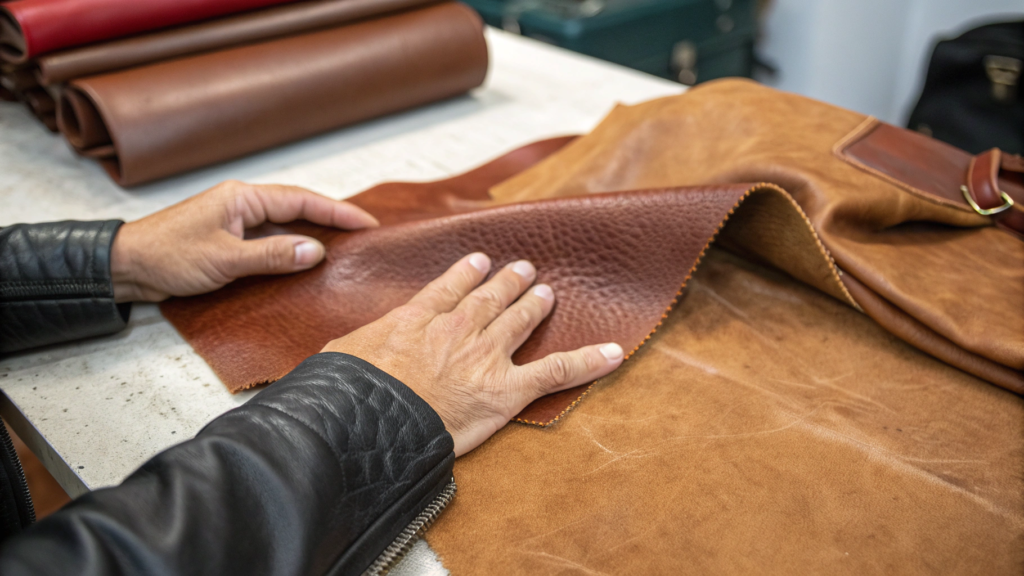
My time in the production and gifting industry taught me that genuine leather is more than just a material; it is a philosophy of durability and accountability. For a marketing manager like Jacky, choosing a genuine leather product—like a wallet or notebook cover—sends a strong message of quality. Synthetic alternatives, no matter how advanced, lack the narrative and longevity of real leather. Let me share the key insights and tests I use to verify authenticity, moving beyond simple labels.
What Is the Symbol for Genuine Leather and Is It Reliable?
Are you searching for a definitive mark that guarantees a product is real leather? Stop relying solely on a small symbol. Understand what the common leather stamps mean and their limitations.
The most common symbol for genuine leather is a stylized hide shape or a small, round stamp. This stamp often includes text like "Genuine Leather1" or "Vera Pelle" (Italian for true leather). While helpful, these stamps are not always a guarantee of quality or type. Authenticity today also requires checking for ethical verification and transparency in the material's sourcing.
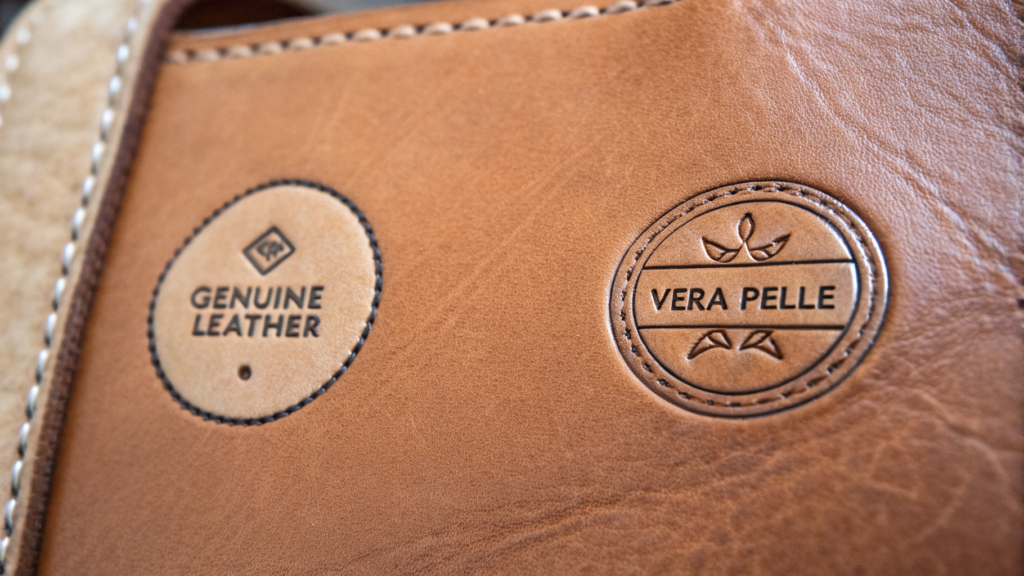
I always tell clients that the leather stamp is a starting point, not the final word. The most recognized symbol is the stylized hide shape. However, the words "Genuine Leather" are often misunderstood. In the industry, Genuine Leather typically refers to the third layer of the hide, which is processed and finished. It is real leather, but it is not the top-tier quality like Full-Grain. This is where transparency comes in. As a modern consumer, knowing if leather is "real" goes beyond physical signs; it requires ethical verification. Brands that use genuine leather should be able to provide details on their sourcing and tanning process. I advise Jacky to look for suppliers who can trace their materials and ensure sustainability practices. The touch test is still key. Real leather feels warm, flexible, and slightly uneven because nature is never perfect. Synthetic materials, even with a stamp, feel cold and perfectly uniform, which ironically becomes their biggest giveaway. The future of authenticity lies in accountability from the supplier, not just a label on the product.
| Tertiary Heading Example | Authentication Method | Expected Result (Genuine) | Limitation of Test |
|---|---|---|---|
| Stamp/Symbol | Look for the stylized hide shape | Shows the product is real leather | Does not guarantee top quality (e.g., Full-Grain) |
| Touch Test | Press the surface firmly | Warm feel, slight wrinkles form | Advanced synthetics can mimic texture |
| Scent Test | Smell the material deeply | Distinct, earthy "leather scent" | Cheap synthetics use strong perfumes |
Is Genuine Leather Always Stamped with a Label or Mark?
Do you automatically reject a product without a visible "Genuine Leather" stamp? Stop passing up high-quality, unmarked items. Understand why many premium products skip the explicit stamp.
No, genuine leather is not always stamped; in fact, high-end or luxury full-grain leather products often omit the stamp entirely. Brands that use the best quality, like full-grain, assume the material's inherent quality, patina, and distinct smell speak for themselves. The absence of a stamp does not mean the material is fake, but rather the brand is relying on the leather's superior feel and appearance to prove its authenticity.
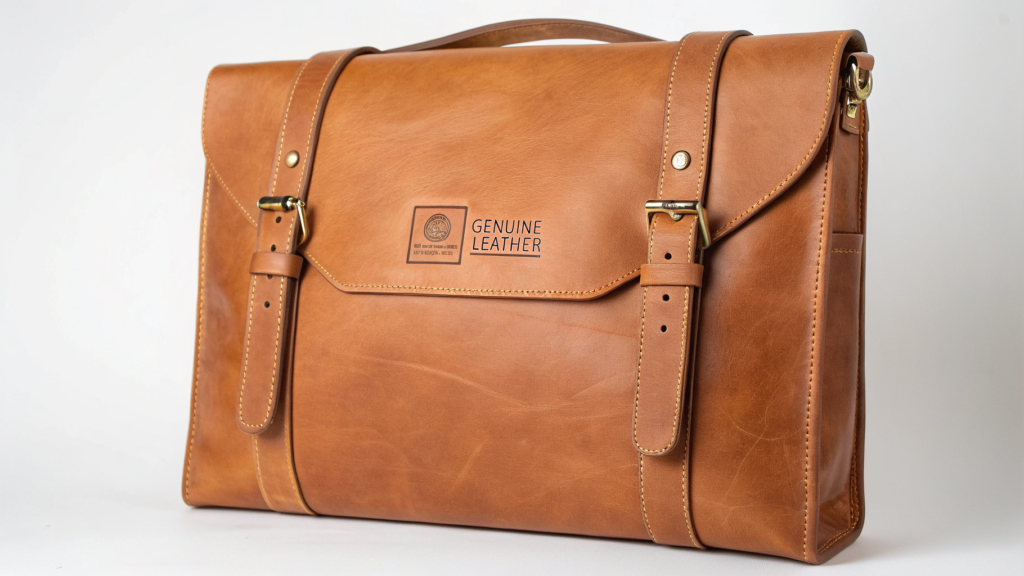
When I worked in production, I realized that stamping is often a feature of mid-range products that need to explicitly state their authenticity. A truly premium leather product, like a vegetable-tanned full-grain wallet, does not need a stamp. The material's characteristics—its depth of color, the fibrous edges, and the way it develops a patina—are the proof. Genuine leather breathes; it changes and softens with time, telling a story through wear. Synthetic materials remain static and flawless, which is a major sign of their artificial nature. When assessing a gift for Jacky's brand, I look closely at the edges. Real leather edges are fibrous and sometimes rough, while synthetic edges often look too clean or are finished with a plastic coating. The flexibility is also a giveaway: real leather is flexible and has bounce-back. Synthetic leather (PU or PVC) often feels stiff and perfectly uniform when bent. The final verification is how the material interacts with water. A tiny drop of water on real leather will be absorbed slightly; on fake leather, it will bead up and sit on the surface. These physical signs are much more reliable than any printed stamp.
| Tertiary Heading Example | Physical Sign | Indicator of Authenticity | Synthetic Counterpart |
|---|---|---|---|
| The Patina | Softens and darkens with age | Tells a story through wear | Remains static and looks new |
| The Edges | Fibrous, slightly rough texture | Natural, untamed look of the hide | Clean, sealed with a plastic coating |
| Water Absorption | Absorbs a small drop quickly | Shows the material "breathes" | Water beads up and rolls off |
What Are the Four Main Types of Genuine Leather Available?
Are you confused by terms like "full-grain," "top-grain," and "genuine" leather? Stop being unsure about the quality hierarchy. Learn the four main types to make an informed buying decision.
The four main types of genuine leather, ranked from highest to lowest quality, are Full-Grain, Top-Grain, Genuine Leather, and Bonded Leather2. Full-Grain is the best, most durable type, showing the natural grain. Top-Grain is slightly sanded for a uniform look. Genuine Leather is a processed lower layer. Bonded Leather is the lowest quality, made from leather scraps and glue.
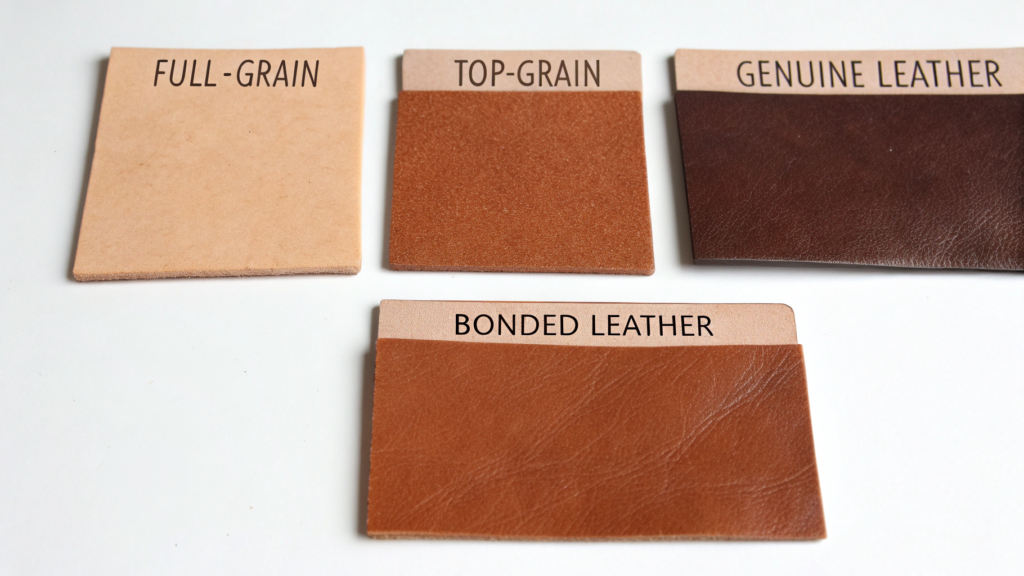
Understanding the hierarchy of leather is vital for setting realistic expectations and budgets. Full-Grain3 Leather is the gold standard. It uses the entire grain layer, which is the strongest and most durable part of the hide. It retains all the natural imperfections, like scars or bug bites, which is why it commands the highest price. It develops the most beautiful patina. Top-Grain Leather is the second-best. It has the top layer shaved off and sanded to remove imperfections, making it thinner and more uniform, but still very durable. Genuine Leather, which often carries the stamp, comes from the third layer of the hide. It is still real, but it is less durable and is often heavily treated to look presentable. This is a common and budget-friendly choice for gifts. Bonded Leather is the lowest quality. It is essentially leather dust and scraps bonded together with a polyurethane or latex adhesive. I avoid this for corporate gifts because it is not durable and rarely lasts, reflecting poorly on the brand. For Jacky, who values high-quality and well-designed gifts, I recommend focusing on Full-Grain or Top-Grain to ensure the gift truly tells a story of durability and imperfection, aligning with the highest brand standards.
| Tertiary Heading Example | Leather Type | Key Characteristic | Ideal Corporate Gifting Use |
|---|---|---|---|
| Best Quality | Full-Grain3 | Highest durability, develops rich patina, shows natural marks | Executive notebooks, long-term gifts |
| High Quality | Top-Grain | Slightly sanded, uniform look, high durability | Premium wallets, high-end accessories |
| Mid-Range | Genuine Leather | Lower layer of the hide, more processed | Budget-conscious items, large-scale events |
| Lowest Quality | Bonded Leather | Scraps bonded with glue, least durable | Avoid for meaningful corporate gifts |
Conclusion
Write a conclusion that summarizes the entire text (max 30 words).
Authenticating genuine leather requires using the touch and flexibility tests, not just the stamp. I recommend choosing Full- or Top-Grain leather to ensure your corporate gift projects durability, accountability, and quality.